

An international genomic study has challenged long-held historical beliefs about the fall of the Roman Empire and the subsequent formation of Central European societies. By analyzing ancient DNA from early medieval row grave cemeteries in southern Germany, researchers have revealed that the transition from Roman rule to the early Middle Ages was not characterized by massive, coordinated invasions of Germanic tribes, but rather by the gradual integration of smaller migrating groups with the established local populations.
The research, led by anthropologist and population geneticist Professor Dr. Joachim Burger from Johannes Gutenberg University Mainz (JGU), was published in the journal Nature. The interdisciplinary team analyzed 258 genomes from individuals buried between 400 and 700 AD in present-day Bavaria and Hesse, comparing them with a reference dataset of nearly 3,000 ancient, early medieval, and modern genomes. The findings provide unexpectedly detailed insights into one of the most transformative periods in European history.
A Gradual Integration, Not a Massive Invasion
For over a century, the period following the collapse of the Western Roman Empire was often associated with the concept of a unified Germanic identity and large-scale migration events - the so-called Völkerwanderung or Migration Period. However, the new genomic data tells a different story of regional mobility and gradual integration. The study found that even before the collapse of Roman rule, individuals with genetic ancestry from northern Europe were already living and being buried in southern Germany - at sites such as Altheim near Landshut and Büttelborn near Darmstadt.
"The results – based on entirely new scientific data – confirm that the traditional view of large, coordinated migrations of Germanic peoples is inaccurate," explained Professor Dr. Steffen Patzold, a medieval historian at the University of Tübingen who co-initiated the study. "Instead, the genomic data point to movements of smaller groups, families, or even individuals." Dr. Jens Blöcher, a population geneticist at JGU and co-first author of the study, noted that these people from northern regions had moved south in small groups long before the end of the Western Roman Empire and had gradually adopted Roman ways of life.
- How the Rise and Fall of the Roman Empire Shifted Populations
- DNA Study Reveals Diversity Among Post-Roman Elites
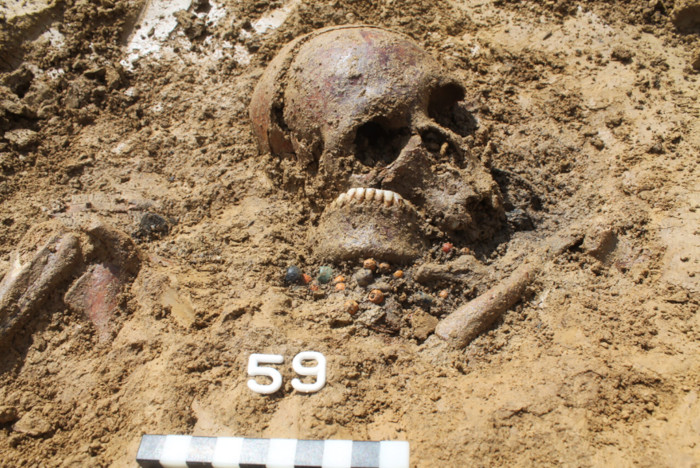
A woman's skull, approximately 1,400 years old, discovered during the excavation of her grave in what is now Ergoldsbach. Using a tiny bone fragment from the skull, palaeogeneticists at JGU reconstructed the deceased's complete genome. (© Richter/Kreisarchäologie Landshut)
Initially, many of these incoming groups appear to have lived separately from the rest of the population, likely as agricultural workers, and tended to marry within their own groups. Dr. Leonardo Vallini, the other first author, suggested that Roman administrative practices may have contributed to this separation, as land was often allocated to incoming groups under specific conditions, including restrictions on marriage, to manage integration and maintain control. For the first time, the research team also genetically characterized the population of a Roman military settlement, finding it to be highly diverse, reflecting centuries of movement and exchange across Europe and even from Asia.
- The Eternal City: Rome After the Fall of 476
- Anglo-Saxon Migration Created a 'European' Medieval England
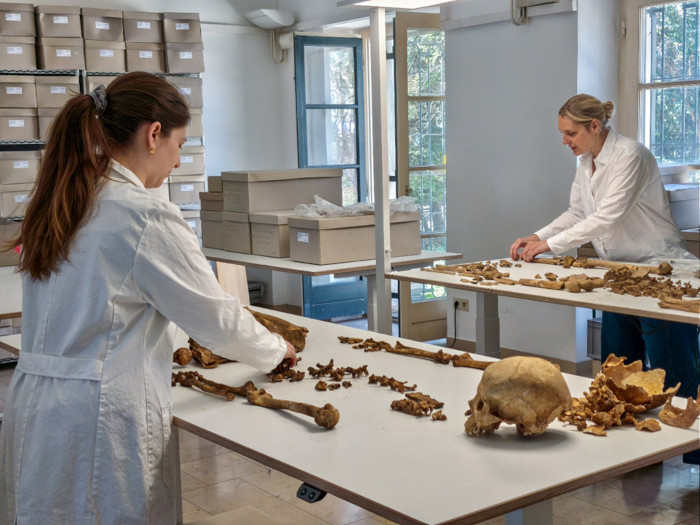
Researchers at the State Collection for Anthropology Munich (SAM) examine skeletons unearthed at the village of Altheim, Germany. (Johannes Gutenberg University Mainz)
The Turning Point: Merging of Populations After 470 AD
The period after around 470 AD marked a significant turning point. With the collapse of Roman state structures, insecurity increased, leading to greater population mobility. People who had previously lived in cities or military settlements moved into rural areas, where they encountered the groups with northern European ancestry. These previously separated groups formed new communities and began to bury their dead together in shared row grave cemeteries - a practice that became widespread from the mid-fifth century across northern Gaul, western and southern Germany, and as far as Hungary.
"There is continuity of population components from late antiquity, but also a clear process of merging between previously separated groups," noted Professor Burger. This rapid formation of families across the two groups suggests a shared cultural framework - the late Roman cultural sphere - which had connected both populations long before the political end of the Empire. The researchers were able to reconstruct family trees showing how new family structures emerged during this period of demographic change.
European Family Structures Rooted in Late Roman Norms
The genomic data also allowed researchers to reconstruct family relationships and household structures during this period of demographic change. The findings revealed that households were primarily composed of nuclear families rather than extended clans. Marriages were monogamous, close kin marriages were avoided, and descent was traced through both maternal and paternal lines—patterns that correspond closely to late antique written sources and demonstrate the lasting influence of late Roman social norms into the early medieval period.
From the seventh century onwards, these processes resulted in a population that is genetically very similar to that of present-day southern Germany. While the northern ancestry component became increasingly prominent, both original groups contributed to the genetic structure of the region. According to Joachim Burger, this development shows how the upheavals of late antiquity gradually formed the basis of the population structure of central Europe that can still be observed today. The study was funded by the German Research Foundation and the Swiss National Science Foundation, and involved around sixty researchers from institutions across Germany, Switzerland, France, England, Spain, Italy, Austria, Serbia, and beyond.
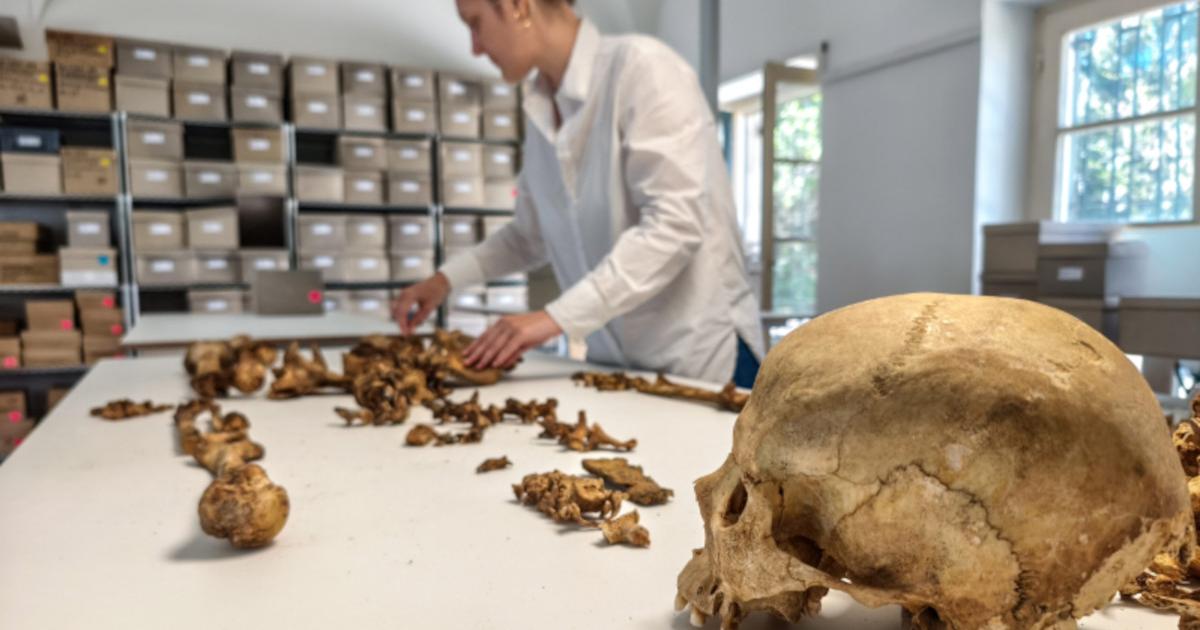
Top image: Researcher at the State Collection for Anthropology Munich (SAM) examine skeletons unearthed at the village of Altheim, Germany. Source: Johannes Gutenberg University Mainz
By Gary Manners
References
Blöcher, J., Vallini, L., et al. 2026. Demography and Life Histories across the Roman Frontier in Germany 400-700 CE. Nature. Available at: https://www.nature.com/articles/s41586-026-10437-3
Johannes Gutenberg University Mainz. 2026. After Rome: genomic insights from southern Germany on the formation of Central European societies. Available at: https://press.uni-mainz.de/after-rome-genomic-insights-from-southern-germany-on-the-formation-of-central-european-societies/
Osborne, H. 2026. Genome study reveals secrets of the fall of the Roman Empire. The Independent. Available at: https://www.independent.co.uk/news/science/genome-study-reveals-secrets-of-the-fall-of-the-roman-empire
Reuters. 2026. Genome study reveals what happened after the Roman Empire fell. Reuters. Available at: https://www.reuters.com/world/genome-study-reveals-what-happened-after-roman-empire-fell-2026-04-29/