In 376 AD, an alarming number of Visigoths erupted on the Danube frontier and overflowed into the northern Roman provinces of the Balkans. The recent arrival of a new invader in Eastern Europe, originating from the steppes of Central Asia, was at the origin of this massive spontaneous migration. In fact, the Huns had invaded and destroyed the kingdom of the Ostrogoth, located in present-day Ukraine, causing hundreds of thousands of them to flee to the West. This significant demographic shift disrupted their immediate neighbours, the Visigoths, who had settled in the region of the ancient Roman province of Dacia, present-day Romania, just north of the Danube.
This demographic pressure, combined with the fear of the Huns, caused this massive overflow of Visigoths into Roman territory. Their request for protection within the borders of the Empire was accepted by the apprehensive authorities on condition that they could be counted on to help defend the region against potential invaders. Once the newcomers settled in Thrace, they were almost immediately exploited by local officials. In 378, united under the command of their leader Fritigern, the Visigoths revolted against Roman authority and began to ravage the region, while other bands of Germanic tribesmen took advantage of the disorder to also cross the Danube.
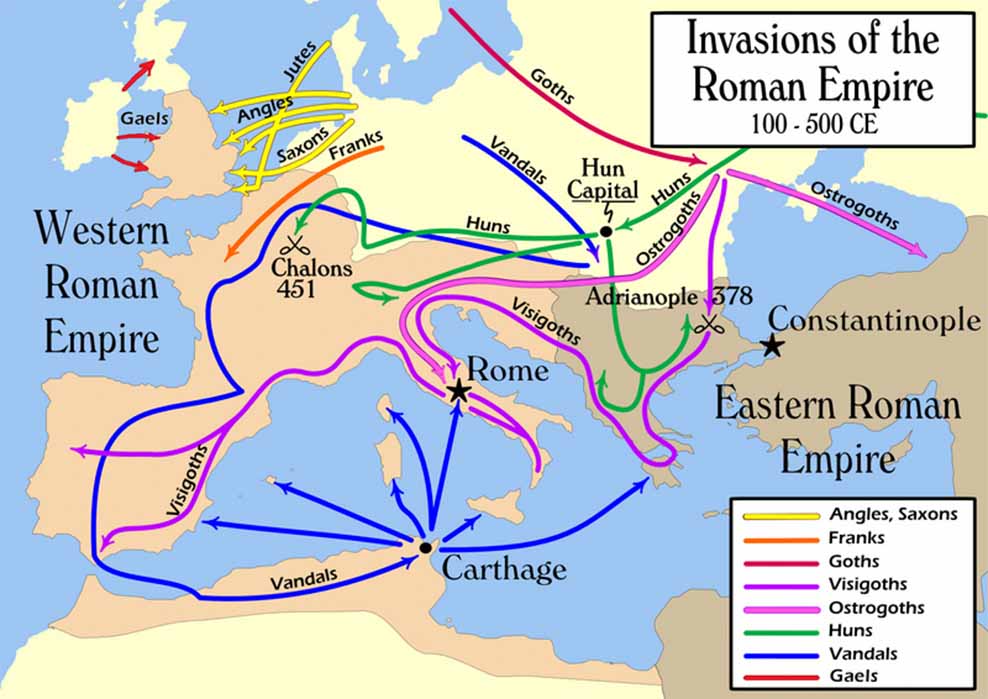
Map of the "barbarian" invasions by the Angles, Saxons, Jutes, Franks, Goths, Visigoths, Ostrogoths, Huns and Vandals of the Roman Empire showing the major incursions from 100 to 500 AD. (CC BY-SA 2.5)
Emperor Valens’ Miscalculation
Following initial military successes by local Roman troops in isolating the Visigoths, the Roman Emperor of the East, Valens, arriving from Asia Minor, hastily organized a massive attack against them near Adrianople without waiting for military assistance from the Emperor of the West, Gratian. The latter had sent Valens an emissary carrying a letter advising him of the arrival of reinforcements. Valens’ officers recommended that he wait for Gratian’s army, but Valens engaged in battle anyway, most likely seeking the glory that would follow a decisive victory for himself. Over-confident, Valens combined his forces and attacked the Visigoth army head-on, although intelligence reports had alerted him that additional Visigoth cavalry was nearby. Before the Romans succeeded in breaking the Visigoth infantry, their flanks were attacked by enemy cavalry.