
2ac2.jpg)

In February 1959, nine experienced hikers vanished in the northern Ural Mountains of the Soviet Union. When their bodies were finally recovered months later, the scene was so bizarre and gruesome that it birthed a mystery lasting over six decades. The Dyatlov Pass incident remains a focal point for researchers, historians, and conspiracy theorists alike. While official reports often cite a "compelling natural force," the specific details of the deaths suggest something far more complex. From radioactive clothing to missing tongues and internal trauma without external bruising, the enigma of Kholat Syakhl continues to defy simple explanations.
The expedition was led by Igor Dyatlov, a 23-year-old engineering student from the Ural Polytechnical Institute. His team consisted of eight other young professionals and students, all of whom were highly trained in long-distance ski tours. They were attempting to reach Mount Otorten, a route classified as Category III, the most difficult level of difficulty. On the night of February 1, 1959, the group pitched their tent on the slopes of Kholat Syakhl, a name translated from the local Mansi language as "Mountain of the Dead." They never made it to their destination.
The Scene of the Crime: A Tent Torn from Within
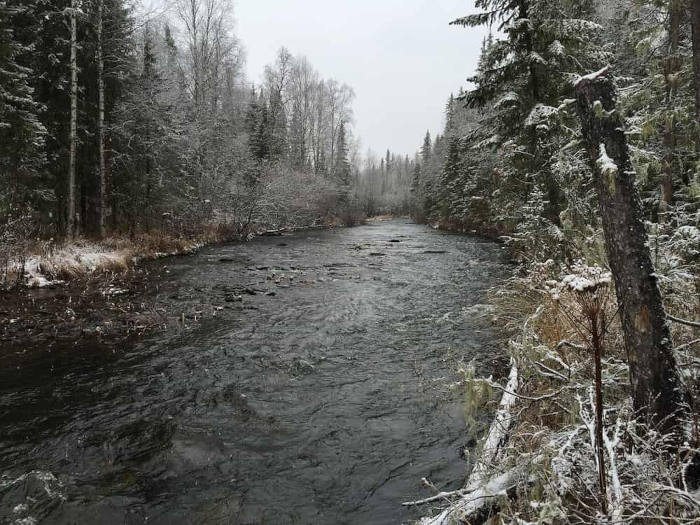
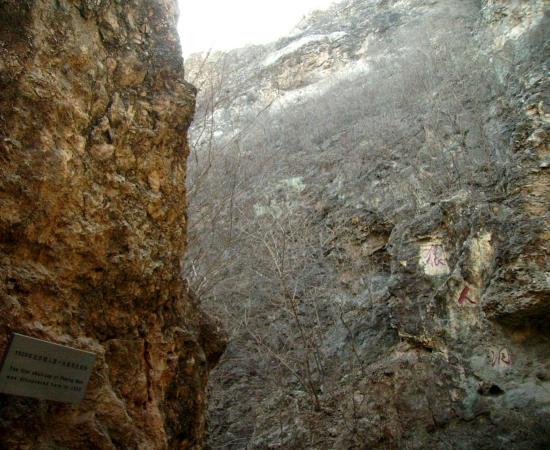
A photograph of the Auspiya River area connected to the Dyatlov route in the northern Urals. (CC BY-SA 4.0)
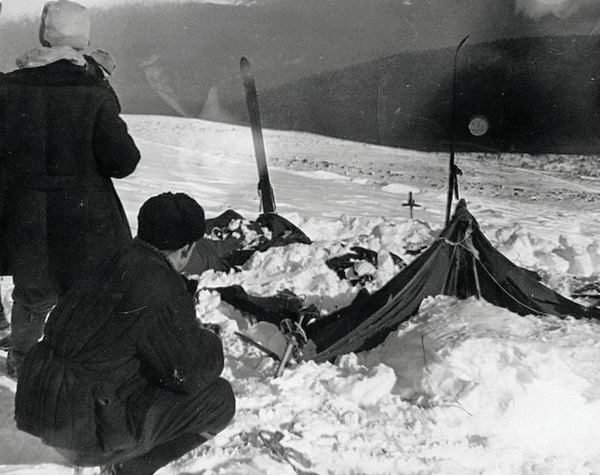
When search parties finally located the campsite on February 26, they found a scene of absolute chaos. The tent had been cut open from the inside, suggesting a sudden, panicked exit. Most of the hikers’ belongings, including their boots and warm coats, were still inside the tent. Despite the temperature being as low as -30°C (-22°F), the hikers had fled into the darkness in their socks or even barefoot. This immediate abandonment of life-saving equipment is one of the most baffling aspects of the Dyatlov Pass incident.
Footprints in the snow led down the slope toward a nearby forest, nearly 1.5 kilometers (0.9 miles) away. Under a large cedar tree, the first two bodies were found: Yuri Krivonischenko and Yuri Doroshenko. They were dressed only in their underwear and were shoeless. Nearby were the remains of a small fire. Interestingly, branches on the cedar tree were broken up to five meters (16 ft) high, suggesting that one of the hikers had frantically climbed the tree, perhaps to look for the tent or to escape a threat on the ground.
Between the cedar tree and the tent, the bodies of Igor Dyatlov, Zinaida Kolmogorova, and Rustem Slobodin were discovered. Their positions indicated they were attempting to crawl back to the tent when they succumbed to the elements. Slobodin was found to have a small crack in his skull, though it was not considered a fatal wound at the time. For weeks, these five deaths were attributed solely to hypothermia, but the discovery of the remaining four hikers in May changed the narrative entirely.
The Forensic Enigma: Internal Trauma and Missing Organs
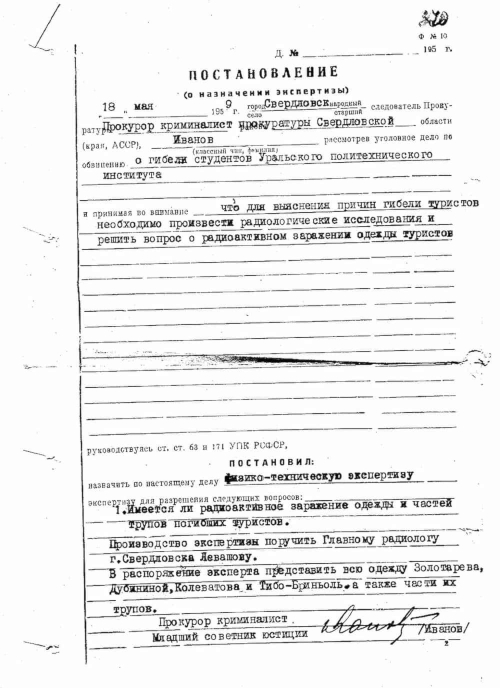
A real archival document image from the original case file, directly relevant to the paragraph discussing radioactive clothing and official testing. (Public domain)
The final four hikers, Dubinina, Zolotaryov, Thibeaux-Brignolles, and Kolevatov, were found buried under four meters (13 ft) of snow in a ravine further into the woods. Unlike the others, these individuals had suffered horrific internal injuries. Thibeaux-Brignolles had a major skull fracture, while Dubinina and Zolotaryov had suffered massive chest fractures. According to the examining doctor, Boris Vozrozhdenny, the force required to cause such damage was comparable to a high-speed car crash.
What made these injuries even more mysterious was the lack of external soft tissue damage. No bruises or hematomas corresponded to the broken bones, as if the hikers had been crushed by a massive, uniform pressure. Furthermore, Lyudmila Dubinina was found to be missing her tongue, her eyes, and part of her lips. While some experts argue this was the result of scavengers or decay in the wet environment of the stream where she was found, the precision of the missing tissue led to decades of speculation about more sinister causes.
Another disturbing detail emerged during the forensic testing of the victims' clothing. Several items were found to be highly radioactive. In the context of the Cold War, this immediately sparked theories about secret Soviet weapons testing in the Ural Mountains. However, the levels of radiation were localized, and some historians point out that the hikers, many of whom worked in nuclear facilities or laboratories, might have been contaminated before the trip began. Nevertheless, the presence of radiation remains a key pillar of the Dyatlov Pass incident lore.
From Avalanches to Infrasound: The Leading Scientific Theories
A dramatic and haunting view of the snow-covered peaks in the Northern Ural Mountains, illustrating the extreme and isolated conditions the Dyatlov group faced on the "Mountain of the Dead." (Public Domain)
In 2021, a new scientific study published in Communications Earth & Environment by Alexander Puzrin and Johan Gaume proposed a "slab avalanche" theory. They argued that a rare type of small, delayed avalanche could have been triggered by the hikers' decision to cut into the snow slope to pitch their tent. This slab of snow could have hit the tent while they slept, causing the severe internal injuries seen in the ravine victims and forcing the group to flee in a state of shock and injury. This is currently the most widely accepted scientific explanation for the Dyatlov Pass incident.
However, many veteran hikers and researchers in Russia remain skeptical of the avalanche theory. They point out that the slope was not particularly steep and that there were no visible signs of an avalanche when the rescuers arrived. Another scientific theory involves "infrasound." This phenomenon occurs when specific wind patterns over the mountains create low-frequency sound waves that are inaudible to the human ear but can cause feelings of intense dread, nausea, and acute panic. Proponents of this theory suggest that infrasound drove the hikers into a temporary madness, causing them to slash their way out of the tent.

Mysterious glowing orange orbs illuminate the night sky over the snowy Ural Mountains on the night of the Dyatlov Pass incident. (Generated)
Secret Weapons and Spheres of Light: The Cold War Shadow
For those who find the natural explanations lacking, the "military" theory offers a darker alternative. During the time of the Dyatlov Pass incident, the Soviet Union was frequently testing missiles and rockets. Witnesses from another hiking group 50 kilometers (31 miles) away reported seeing strange "orange orbs" in the sky on the night the group died. Some believe the hikers accidentally entered a forbidden testing zone and were killed by a fuel-air explosive or a falling rocket stage, which would account for the pressure-based internal injuries and the radiation.
The lead investigator in 1959, Lev Ivanov, later admitted in 1990 that he had been ordered to close the case and classify the findings. He personally believed that the "flying spheres" had something to do with the deaths. Furthermore, the location of the incident was near the Mansi people’s sacred lands. While early suspicions fell on the Mansi, there was no evidence of a struggle or other human tracks in the area. The Mansi themselves have their own legends about the mountain, warning that it is a place where "nine" of anything, men or animals, will surely meet their end.
As we look back at the Dyatlov Pass incident today, it serves as a grim reminder of the power of the wilderness and the limits of forensic science. Whether it was a freak meteorological event, a military accident, or something even more inexplicable, the nine hikers of Kholat Syakhl have become part of the mountain's eternal history. Their story continues to resonate because it taps into our deepest fears: the unknown, the dark, and the "compelling force" that we cannot control.
Top image: The Dyatlov Pass Incident: New Forensic Perspectives on the Ural Mountains’ Greatest Mystery Illustration. Source: AI Generated
References
Gaume, J., and A. M. Puzrin. 2021. “Mechanisms of slab avalanche release and impact in the Dyatlov Pass incident in 1959.” Communications Earth & Environment 2, Article 10. Available at: https://www.nature.com/articles/s43247-020-00081-8
Puzrin, A. M., and J. Gaume. 2022. “Post-publication careers: follow-up expeditions reveal avalanches at Dyatlov Pass.” Communications Earth & Environment 3, Article 63. Available at: https://www.nature.com/articles/s43247-022-00393-x
Romy, C., D. Eidenbenz, S. Grabherr, K. Zafren, C. Jaques, N. Hall, and M. Pasquier. 2025. “Causes of death and types of injuries of avalanche fatalities based on forensic data: a scoping review.” Resuscitation Plus 26:101101. Available at: https://pmc.ncbi.nlm.nih.gov/articles/PMC12506530/
FAQs
1. Was the Dyatlov Pass incident caused by a Yeti? While "Yeti" or "Menk" theories are popular in tabloids and folklore, there is no physical evidence, such as non-human tracks or hair samples, to support the idea that an unknown primate attacked the group. The internal injuries were more consistent with pressure or impact than a physical struggle.
2. Why was the hikers' clothing radioactive? Small amounts of radiation were found on a few pieces of clothing. Some researchers believe this was due to the hikers' professional backgrounds in technical institutes that handled radioactive materials, while others suggest it came from fallout from secret atmospheric tests occurring in the USSR at the time.
3. Has the case been officially solved by the Russian government? In 2020, the Russian Prosecutor General's office concluded that the cause of death was a combination of an avalanche and poor visibility, which prevented the hikers from returning to their camp. However, many independent researchers and family members of the victims continue to dispute this conclusion.