
About 1,500 years ago, in what is now South Korea, a gruesome practice known as ‘sunjang’ dictated that servants, retainers, and even entire families be killed and buried alongside local royalty. A groundbreaking new genetic study of dozens of ancient skeletons has now revealed the existence of a special "sacrificial caste" of people whose grim duty was passed down through generations to serve the elite in the afterlife.
The study, published in the journal Science Advances, analyzed genome-wide data from 78 individuals excavated from the Imdang-Joyeong burial complex in Gyeongsan, South Korea. These tombs date back to the 4th and 6th centuries AD, a time when the powerful Silla Kingdom was consolidating its control over the Korean Peninsula. The findings provide the first large-scale scientific evidence of the social structure and customs of the era, confirming that human sacrifice was an institutionalized and family-based practice.
A Macabre Family Tradition
The Imdang-Joyeong burial complex, first excavated in 1982, contains more than 1,600 tombs and the remains of at least 259 individuals. The graves belonged to local ruling families descended from Abdok, a small state assimilated into the Silla Kingdom around the 4th century. While historical texts like the Samguk Sagi (Chronicles of the Three States) mention the practice of sunjang, the new DNA analysis paints a far more detailed and disturbing picture of how it was carried out.
- Man Buried Alive Next to Master in Silla Kingdom Tomb
- New Evidence of Human Sacrifice in Silla Dynasty's Wolseong Palace
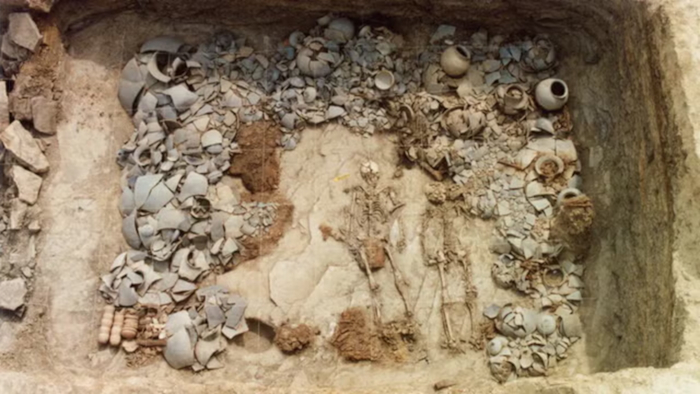
Human skeletons found during excavation of an ancient burial site from the Apdok Kingdom, a part of the Three Kingdoms period in Korea (Gyeongsan City)
Researchers discovered that at least 20 of the tombs displayed evidence of sunjang. Most shockingly, they identified three cases where closely related individuals, including parent-child pairs, were sacrificed and interred together in the same tomb. One burial contained both parents and their child, sacrificed together to accompany a deceased noble. "Our genetic findings are the first to confirm the acts of sunjang of an entire household," the researchers wrote in their paper.
The team reconstructed 13 family trees spanning over a century, revealing an extensive kinship network focused on maternal lineages. The genetic relatedness among sacrificial individuals over generations suggests the presence of specific families that served as sacrifices for the grave owner class for consecutive generations, effectively forming a sacrificial caste.
- Discovery of Ancient Tomb Suggests Man was Sacrificed to Serve a Korean Noblewoman
- The Age-Old Bone-Rank Caste System of the Korean Kingdom of Silla
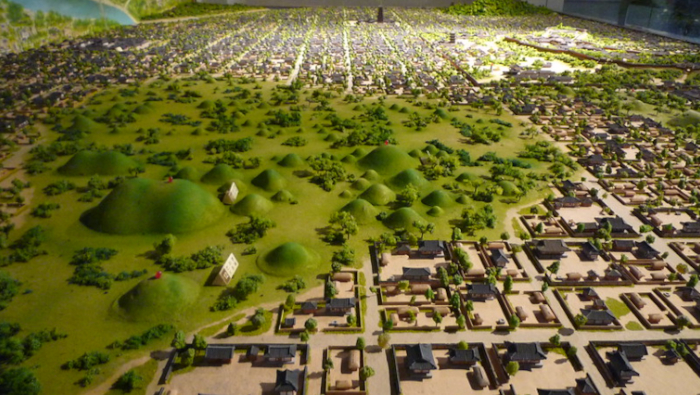
Diorama showing Gyeongju at the height of the Silla kingdom. The green area in the foreground are the tombs of the Silla kings. (Johnathan O’Donnall/CC BY-NC-ND 2.0)
Close-Kin Marriage Among Elites and Servants
The study also shed light on the marriage practices of the Silla Kingdom. Historical records have long suggested that Silla royal elites practiced consanguineous (close-kin) marriage to consolidate rank and social status, a practice distinct from neighboring kingdoms like Goguryeo. The DNA analysis confirmed this, but with an unexpected twist. Researchers found five individuals whose parents were closely related, including one first-cousin pairing. Surprisingly, this close-kin marriage was practiced by both the royal elites (the grave owners) and the non-royal individuals who were sacrificed, indicating that endogamy was practiced broadly across social groups rather than being confined solely to the elite class.
Furthermore, the genetic data revealed no meaningful distinction between the grave owners and those sacrificed. Both groups belonged to the same local population, proving that the sacrificial victims were not outsiders, prisoners of war, or captives from other regions, but rather members of the local community. Jack Davey, director of the Early Korean Studies Center in Cambridge, Massachusetts, noted the profound implications of the study:
"If correct, the presence of what seems to have been a sacrificial caste in this regional polity outside of the Silla core has profound implications for how we understand Silla society," he told Live Science.
The findings raise complex questions about slavery, social mobility, and institutionalized violence in the 1,500-year-old kingdom.
The End of Sunjang
The practice of sunjang was rooted in the belief that the dead would require attendants, servants, and even family members in the afterlife. The victims were often buried in a subsidiary chamber next to the main chamber containing the grave owner. However, as the Silla Kingdom grew more centralized and influenced by Buddhism, attitudes toward human sacrifice began to shift. According to historical records, the practice of sunjang was formally abolished in 502 AD during the reign of King Jijeung. The prohibition marked a significant cultural and religious shift in ancient Korean society, moving away from institutionalized human sacrifice toward more symbolic offerings.
This groundbreaking research not only confirms the grim reality of human sacrifice in ancient Korea but also highlights a unique family structure and kinship network that differs significantly from those observed in ancient Europe and elsewhere. The researchers noted that the Silla Kingdom's family structure was focused on maternal lineages, a pattern not commonly seen in other ancient societies of the era.
"We believe further archaeogenetic studies on the Korean peninsula will reveal more information on the population dynamics and family structures of ancient East Asia," the researchers wrote.
As further work is conducted on the Three Kingdoms period, more secrets of this remarkable civilization are sure to emerge.
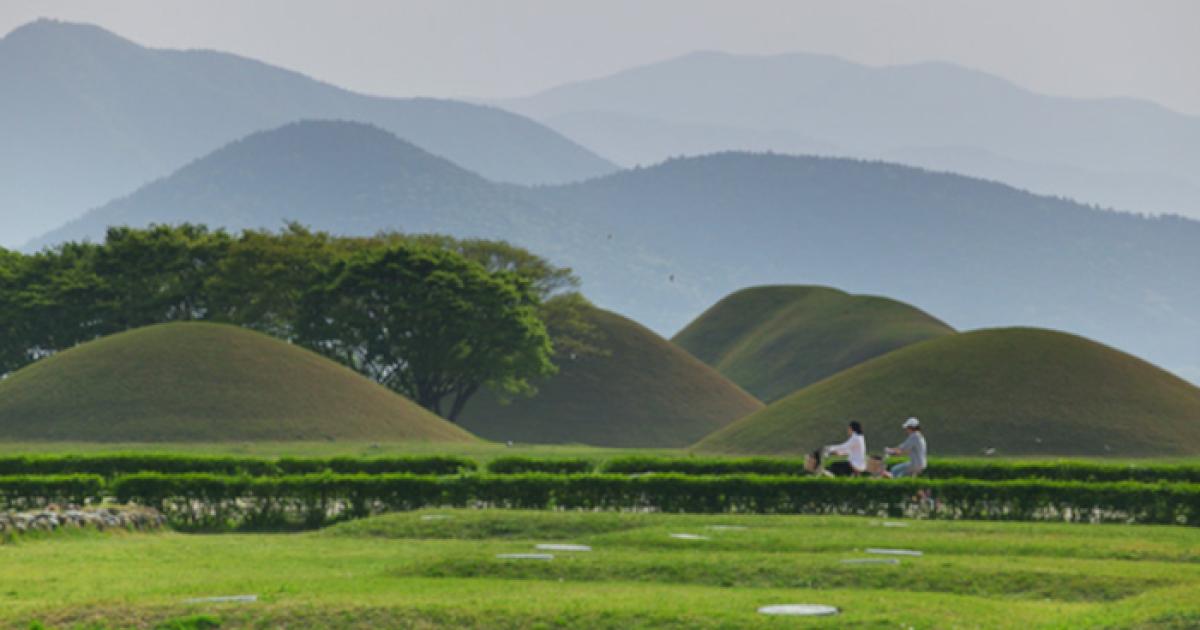
The mound tombs of Gyeongju (Geumseong), capital of the Silla Kingdom, which ruled Korea from the 1st century BC to the 10th century AD. Source: Jeong woo Nam/CC BY NC-ND 2.0
By Gary Manners
References
Killgrove, K. 2026. Entire lower-class families were sacrificed to honor local royalty 1,500 years ago in Korea, DNA analysis reveals. Live Science. Available at: https://www.livescience.com/archaeology/ancient-korean-society-practiced-human-sacrifice-and-high-inbreeding-researchers-find
Moon, H., Kim, D., Hiss, A.N., Lee, D.-N., Lee, J., Skourtanioti, E., Gnecchi-Ruscone, G.A., Krause, J., Woo, E.J., Jeong, C. 2026. Ancient genomes reveal an extensive kinship network and endogamy in a Three-Kingdoms period society in Korea. Science Advances 12(15 ). Available at: https://doi.org/10.1126/sciadv.ady8614
Park, J. 2026. Ancient DNA reveals close-kin marriage, family-based sacrificial burials in Silla. The Korea Herald. Available at: https://www.koreaherald.com/article/10713791
Sankaran, V. 2026. Ancient Korea had people from 'sacrificial caste' killed to please royalty, skeletons reveal. The Independent. Available at: https://www.independent.co.uk/news/science/archaeology/ancient-korea-sacrificial-caste-skeletons-royalty-b2735001.html