In a remarkable archaeological breakthrough, researchers at the Áspero archaeological site in Peru have unearthed a complex stone structure that served as an ancient astronomical observatory. The newly discovered building, linked to the Caral Civilization, suggests that specialists over 4,000 years ago meticulously tracked celestial bodies to manage their relationship with the natural environment. The finding highlights the profound scientific knowledge possessed by one of the oldest known societies in the Americas, pushing back the timeline of advanced astronomical observation in the region.
The discovery was presented by researchers from the Caral Archaeological Zone, led by the prominent Peruvian archaeologist Ruth Shady Solís. Situated in Supe Puerto within the Barranca province, Áspero was an ancient fishing city occupied between 3000 B.C. and 1800 B.C. The monumental find coincides with the commemoration of 21 years of dedicated research, conservation, and enhancement work at the coastal settlement. During excavations in an area designated as Sector J1, the team identified the specialized structure strategically positioned near the settlement’s main pyramidal buildings.
From this elevated vantage point, ancient observers commanded a clear view of the Pacific coastline and the lower part of the Supe Valley. According to the site's chief archaeologist, David Palomino, the structure was deliberately designed to cast shadows on its surface, allowing specialists to determine natural cycles and the movements of the sun, the moon, and other celestial bodies. This systematic monitoring would have been critical for planning productive activities, particularly fishing and shellfish gathering, which formed the foundation of the local economy. As noted in studies of daily life in the 5,000-year-old city of Caral, astronomical knowledge was closely tied to agricultural and marine cycles throughout the civilization.
- Elite Caral Woman Buried with Exotic Feathered Artifacts
- Excavations Reveal a 3500-Year-Old Trading City in Peru
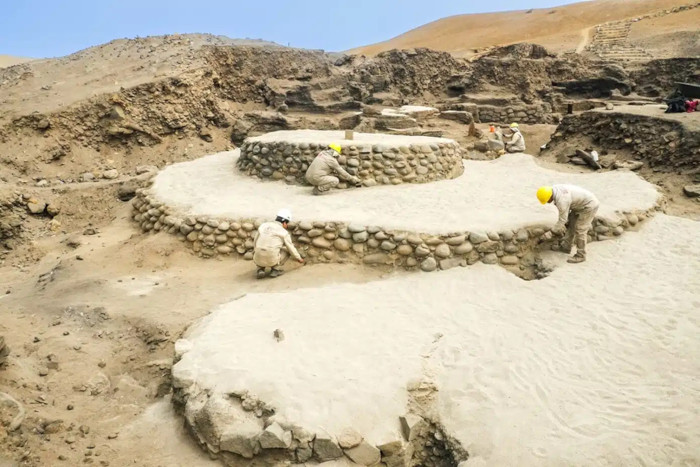
Archaeologists work on the circular stepped platform. (Peru Ministry of Culture)
The Evolution of an Ancient Observatory
Excavations have revealed that the astronomical structure went through at least four distinct construction phases, reflecting its evolving function within the community. In its earliest stage, the building likely served as a public ceremonial space. Later, the builders added an oval platform measuring approximately 3.18 meters (10.4 feet) in diameter and 63 centimeters (2.1 feet) in height. At the center of this platform stood a vertical stone known as a huanca, a feature widely associated with ritual practices in Andean cultures.
During a subsequent phase, the structure was expanded into a more elaborate double-stepped platform. The lower level measured about 9.40 meters (30.8 feet ) in diameter, while the upper platform spanned 4.80 meters (15.7 feet). At its center, archaeologists uncovered a rectangular stone alongside a nearby ceremonial hearth, similar to the 5000-year-old Fire Altar found at other Caral sites. These features suggest an intensification of ritual activity intrinsically linked to the observation of natural cycles.
Interestingly, the distinctive two-level design of the Áspero observatory sets it apart from similar structures found in other areas influenced by the Caral civilization. Palomino noted that this unique architectural detail could be directly related to the site's proximity to the coastline. While agriculture represented another food source for the settlement, the water in the Supe River becomes scarce between April and November, making the prediction of tides and marine shifts vital for survival.
- Discovery at Oldest Observatory in the Americas Pushes Back Origins of Peruvian Astronomy
- Chankillo: The Oldest Solar Observatory in the Americas
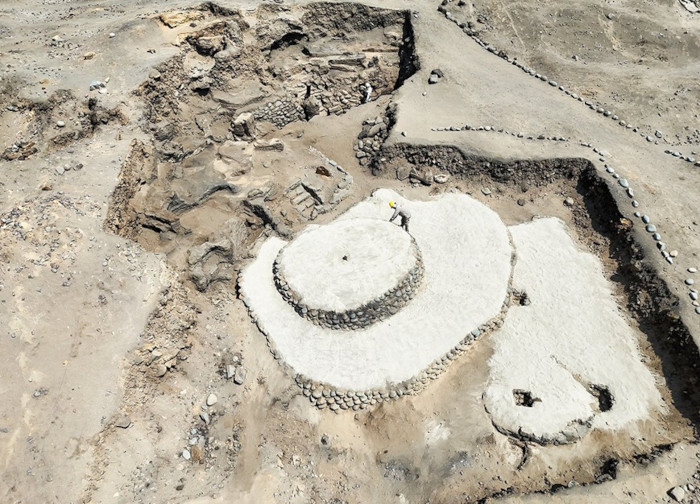
Aerial view of the excavated structure at Áspero. (Ministry of Culture)
A Hub of Knowledge and Exchange
The Áspero settlement covers nearly 19 hectares and includes more than 20 architectural complexes, indicating a highly organized society. The Norte Chico civilization, to which Caral and Áspero belong, was not merely a collection of isolated fishing villages but a complex network of interacting communities. Goods moved constantly between the coast and inland areas, linking settlements with different resources.
Evidence of this extensive interaction was found in the tombs and homes of Áspero, which contained both Amazonian and Andean elements. The site has previously yielded significant discoveries, including high-status burials like the famous "Lady of the Four Tupus," which, alongside other 4500-year-old burials, points to a society with clear social ranking and organized activity.
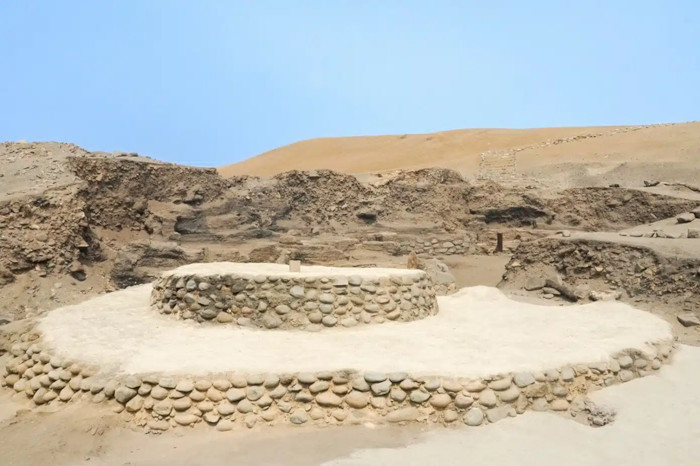
A view of the restored stone-built platform at Áspero, Peru. (Peru Ministry of Culture)
In its final stage, the astronomical structure was covered and converted into residential spaces. Researchers interpret this shift as a reflection of broader social changes and a decline in the building's specialized role. Nevertheless, the discovery confirms the sophisticated level of knowledge achieved by these ancient people. It demonstrates that observing the sky was not separate from daily life; rather, it formed an integral part of how they organized work, understood their world, and adapted to their environment.
Top image: Aerial view of the Áspero archaeological site showing the newly discovered structure. Source: Peruvian State/Andina
By Gary Manners
References
Andina. 2026. Peru: Aspero discovery reveals millennia-old structure linked to astronomical observation. Andina - Peru News Agency. Available at: https://andina.pe/ingles/noticia-peru-aspero-discovery-reveals-millenniaold-structure-linked-to-astronomical-observation-1072017.aspx
Milligan, M. 2026. Ancient Caral structure linked to astronomical observation discovered at Áspero. HeritageDaily. Available at: https://www.heritagedaily.com/2026/04/ancient-caral-structure-linked-to-astronomical-observation-discovered-at-aspero/157854
Zahid, N. 2026. Ancient Astronomical Structure Discovered at Peru’s Áspero Site. GreekReporter.com. Available at: https://greekreporter.com/2026/04/21/ancient-astronomical-structure-discovered-at-perus-aspero-site/