Picture
    ῲ If you are doing color work with stranding or slip stitches and have trouble keeping the threads being carried over on the wrong side loose enough, hold one or two of your left hand fingers between the knitting and the stranding when you are forming a stitch with the contrast color that is going across more than 2 or 3 stitches in the back. That much extra is usually just enough to allow for the stretch of stockinette stitch and keep it from pulling too tight. Eventually you may be able to skip this step as you get used to the looser tension.
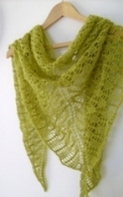
    ῲ If you are making a shawl, scarf, or any lacework that will be stretched in blocking and has a knit in the front and back increase, consider doing a knit and purl in the same stitch instead. It is a bit more elastic and the purl bump is not much different from the bump you get with Kf&b. In any case, it is useful to be familiar with many types of increases so you choose what looks and functions best for the project you are working on.
    ῲ Use spare circular needles as stitch holders. This is useful when instructions call for moving stitches to waste yarn because it is quicker to transfer them back again onto the real needle when needed. And it can help if you want to try on something in progress, even if it is being knit on dpns.
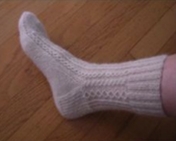
    ῲ Sock patterns worked cuff down often call for decreases every other round at the toe. Try doing that until your stitches are decreased by half and then decrease every round until they are halved again, then do the grafting/kitchener stitch. The result is a really well fitting sock.
    ῲ To get a snug fitting wrist for mitts, use a smaller needle size for the ribbing and consider adding a cable twist, even if it is only twisted in one or two rows. The twist will pull in the wrist part just enough to ensure they are loose around the wrist after being pulled on and off in 
everyday wear.
    ῲ When picking a pattern to knit, think function and scrutinize photos on Ravelry. Too often photographs show a sweater hanging up, shawls laid out, and socks on a sock blocker. This does not tell you at all how what those finished objects look like when worn or whether they will work on the body that you want to make them for.
    ῲ This website shows the most common kinds of increases very clearly, though not k and p into the same stitch: http://www.knitty.com/ISSUEwinter09/FEATwin09TT.php.

    ~Aleen Caplan-Yamasaki, Vice President


    Last night at the August Guild meeting, Barb and Aleen treated us to a short tutorial on short rows. Barb showed us the method that Cat Borhdi uses on her Sweet Tomato Heel, and demonstrates in this YouTube video. You do need to be patient, since she works through the entire heel in this video, but it really shows how she picks up the 'mother' stitch and knits it together with the 'daughter' stitch, resulting in a hole-less no wraps short row heel. 

    Aleen shared with us her recommendations for short rows and we looked over will have some demos and discussions of short rows. To supplement what we’ll cover during the meeting, I highly recommend TECHknitting's blog, She very clearly demonstrates (with graphics) some of the differences between different methods as well as where each technique might be used best. Aleen also shared some additional techniques in this month's newsletter; 

    "To supplement what we’ll cover during the meeting, I highly recommend a blog post on Short Rows on Tech Knitting, one of the most complete sources of short row methods with the clearest diagrams. You will probably want to bookmark it for future reference. It not only gives details and summarizes in two different ways (regular and geek), it also says which method is best for a particular situation (stitch used or personality type as the case may be). Another great source for tips in general is the Jimmy Beans Wool website. I have never ordered anything from them but went to the website when I saw a tip listed in an ad in a knitting magazine. In this column in the past, I have mentioned the use of things like rubber bands and paper clip in a pinch when you don't have your knitting tools with you. Well, the ad tip had the same philosophy. It suggested that a knitter on vacation caught without a point protector could use the cork from the bottle of Merlot they surely must be drinking!"

    We also had several new members sign up with renewing members, so that they could take advantage of our current "Two for $50" Membership deal. So bring a friend when you renew your membership for the 2012/2013 Membership year (starting in October) and you both can save $5 off your membership fees. Be sure to check out the rules on our Membership page

    If you have never been to a meeting and would like to see what it is all about, come to our September meeting. We will be celebrating our birthday, so there will be cake. We will also be talking about holiday gifts for knitters and for knitters to give.
 
 
Picture
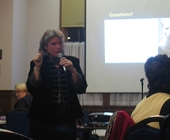
I was really pleased to see that we had so many knitters attend the meeting. I really enjoyed Charisa's presentation on how to take good photos. Two things that really stood out for me was:
  1. get it off the bed/table-great advice, I'm looking forward to playing around with that idea and
  2. use your camera to capture colors in nature for inspiration on choosing color schemes for knitting projects~ what a novel idea! :) 

    I really liked Melissa's [Knit New(s)presentation. She did an awesome job and her visuals were beautiful~ I felt really nostalgic, my mom used to make beautiful granny afghans, the ones that Melissa showcased were lovely. I also really related to what Melissa said, during her presentation, about always choosing black/browns or neutral colors for garments... I do the same, I don't feel confident picking colors a lot of times, and having some inspiration from nature or a photographic source would be great.
    
    I liked that we all got to vote on a bag for the Seattle to Portland Yarn Train, and I'm excited that I'm going to be able to attend this year. It will be my first time on this trip and only my second time on a train.

    I think this is going to be a great year for the guild, and it's great to be able to connect with so many creative people.

     ~Lois, SKG Secretary, 2011-2012


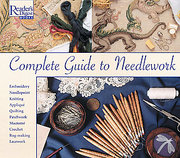
Reader's Digest Complete Guide to Needlework

Picture

Rather than a specific technique, my tip this month is to pick up a specific reference book, out of print but readily available at used bookstores.  It is the Reader’s Digest Complete Guide to Needlework. It first came out in the late 1970’s and then was revised in the 1980’s.  Since then there have been other knitting specific reference books published, but none compare to this. 
  

It has chapters on crochet, tatting, quilting, and more.  But even if you only use it for the knitting, it is worth it.  It doesn’t have some of the more recent techniques like Mobius or i-cord.  But it has the clearest photographs and illustrations.  And what it does have that other books don’t, is discussion of when and why one technique might be better than another in any given situation.  For example, many basic knitting books give instructions for several different cast on’s. But the Reader’s Digest Complete Guide to Needlework not only shows them more clearly, it specifies which is more elastic, which is better to use when firmness is needed, etc.  
 

Have you cringed when you saw the words “provisional cast on” in a pattern?  No problem if you have this book on your shelf.  One online reviewer I saw recently stated that she had long ago sold or given away her copy, only to re-buy it later because it is so indispensable.  Of course you can try amazon.com.  But I would like to suggest your local used bookstores as well as two sites that list the stock of used booksellers across the country, abebooks.com and alibris.com.  I have also had great luck with knitting books from powells.com

 - Aleen Caplan Yamasaki
If you have a question or suggestion for Tips & Tricks, please email Aleen.